Posts tagged linguistics

Page 2 of 2

울고 웃고 그러면 똥구멍에 털이나온다.

“If you start laughing in the midst of crying, you will grow hair out of your butt. Small horns will also grow out of your butt. When horns and hair grow out of your butt, it has a bad connotation.”

Tears and Laughter Together Are Bad Luck | USC Digital Folklore Archives

“Overall, the moral of the saying is that you should choose which mood you are in – do not be bipolar or wishy-washy. Literally it is saying that you should either cry or laugh, don’t try to do both. It transcends this literal situation to imply that one shouldn’t desire to do everything in life.“
Published

In other nose-related etymological news, “nostril” = “nose +‎ “thirl”. A “thirl” = “hole”, but also a “smoot”.

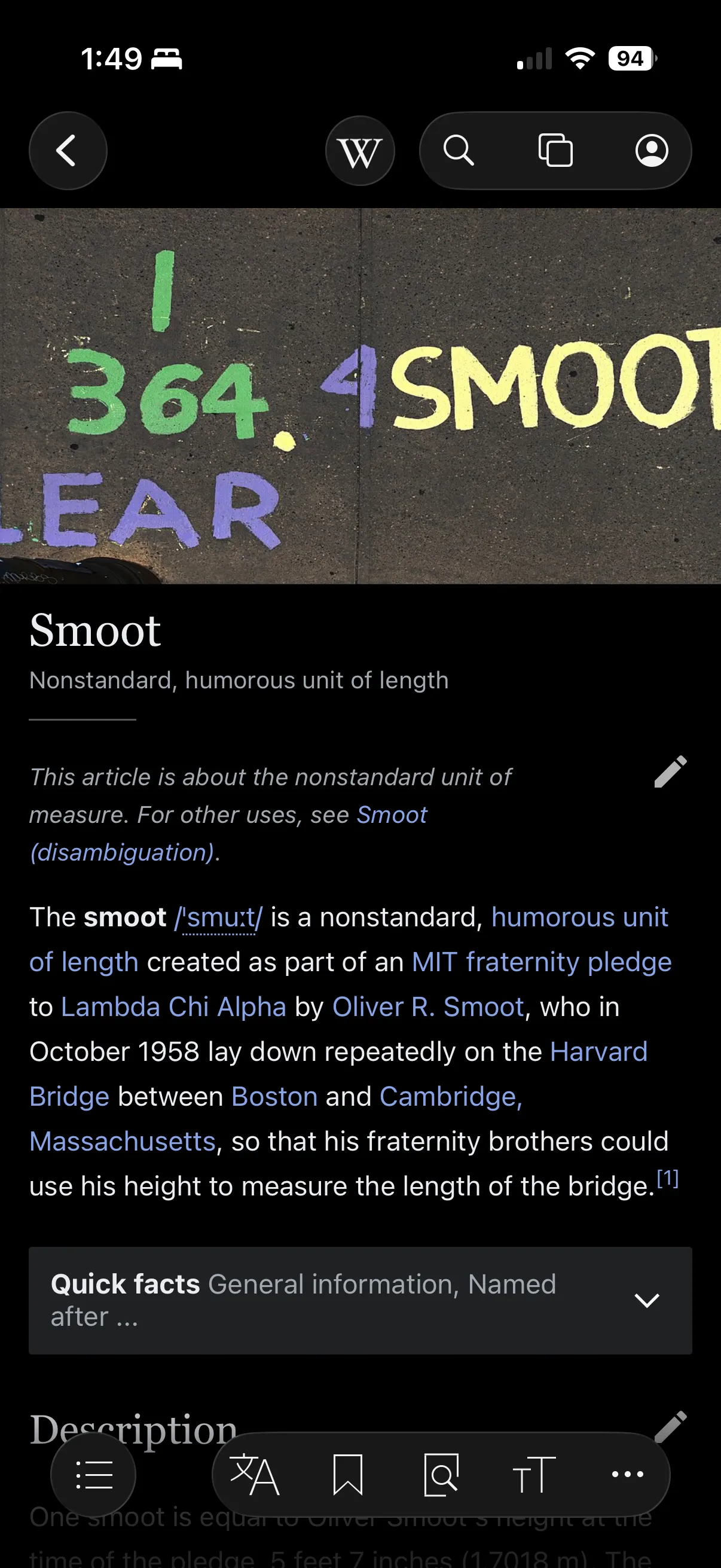
A “smoot”, in turn, is either a “small opening built into a dry-stone wall to allow sheep to pass through”, or alternatively 5 feet 7 inches, the exact height of this guy Oliver Smoot.

Smoot - Wikipedia

Phone screenshot of the Wikipedia article “Smoot”, a nonstandard humorous unit of length, headed by a photo of “364.4 SMOOTS” painted across the Harvard Bridge.

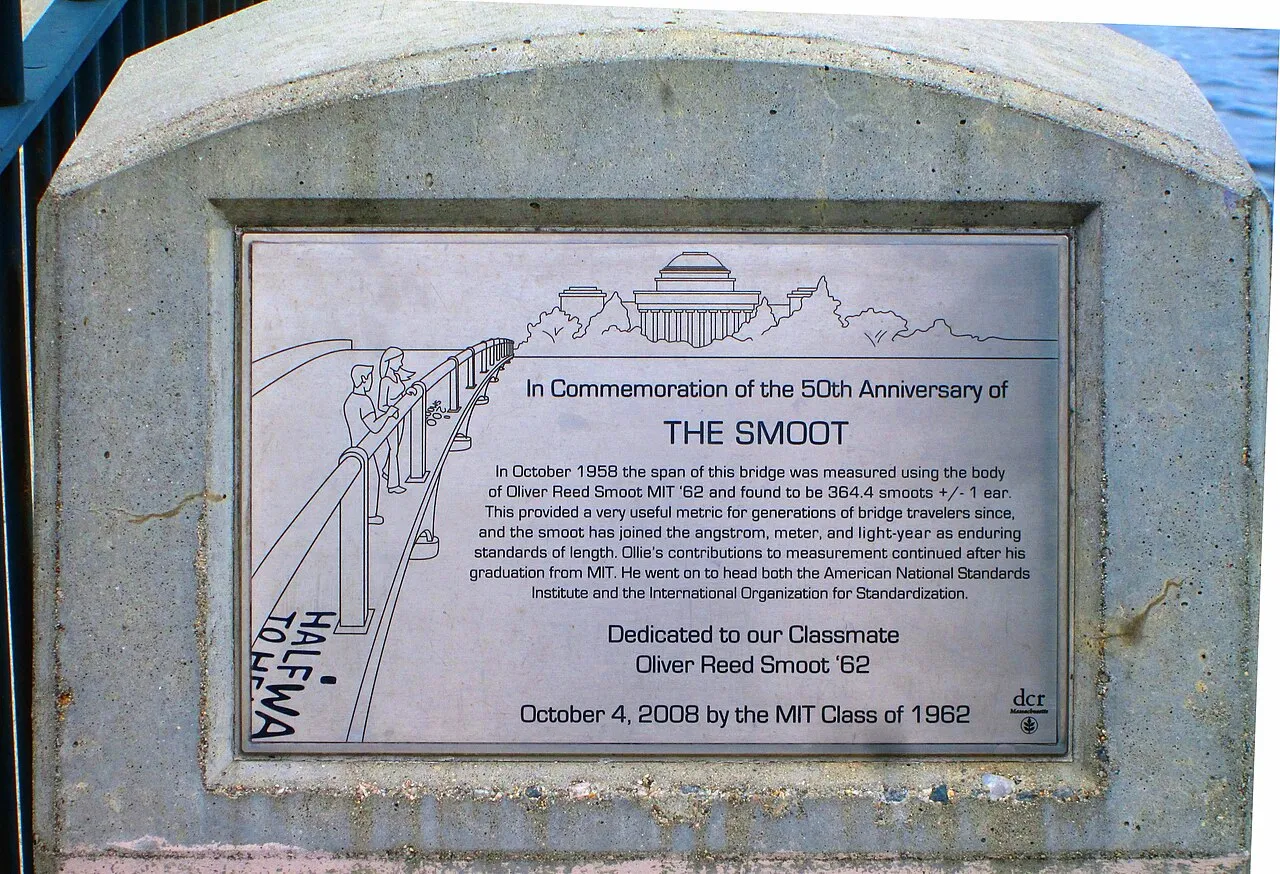
He’s even got a plaque! And he went on to head both the American National Standards Institute and the International Organization for Standardization!

A stone plaque on the Harvard Bridge commemorating the 50th anniversary of the smoot, dedicated to Oliver Reed Smoot by the MIT Class of 1962.

Oh wow, Wikipedia’s List of Non-Coherent Units of Measurement is a goldmine.

List of non-coherent units of measurement - Wikipedia

The “garn”:
NASA’s unit of measure for symptoms resulting from space adaptation syndrome, the response of the human body to weightlessness in space, named after US Senator Jake Garn, who became exceptionally spacesick during an orbital flight in 1985”

The “crab”:
the intensity of X-rays emitted from the Crab Nebula at a given photon energy up to 30 kiloelectronvolts

Crab (unit) - Wikipedia

The “micromort”:
a one-in-a-million chance of death. Smoking 1.4 cigarettes or driving 230 miles costs roughly one micromort.

Micromort - Wikipedia

“Banana equivalent dose”
The amount of radiation absorbed from eating one banana

Banana equivalent dose - Wikipedia

Oh snap move over “List of Non-Coherent Units of Measurement”, hello “List of humorous units of measurement”

List of humorous units of measurement - Wikipedia

“Ohnosecond”
the second after one makes a terrible mistake, such as deleting the wrong file or sending a text message to the wrong person, where the person in question can do nothing but say “oh no”

“Sheppey”
the closest distance at which sheep remain picturesque (created by Douglas Adams!

“Bruno”
the volume of the dent left in asphalt pavement after a piano is dropped six stories from the roof of MIT’s Baker House. Named for the student who noticed that the rules prohibited throwing objects from windows but not dropping them from the roof.

“Millihelen”
the amount of beauty required to launch one ship. Because Helen had the “face that launched a thousand ships”. A negative helen is sufficient ugliness to beach ships. Very timely with The Odyssey out now.

“Bee’s dick”

An Australian term for a very small distance, as in “he missed crashing into the truck by a bee’s dick”. It is derived from the small size of a male bee’s penis. The entry then links to the page for the actual organ

Drone (bee) - Wikipedia

“Standardized giraffe unit”

The standardized giraffe unit (SGU) is proposed by the European Space Agency’s Near-Earth Object Coordination Centre as a standardized unit for animal size reference. A corgi is 0.05 giraffes, while an elephant is 1.25 giraffes.

Published
Published
Published

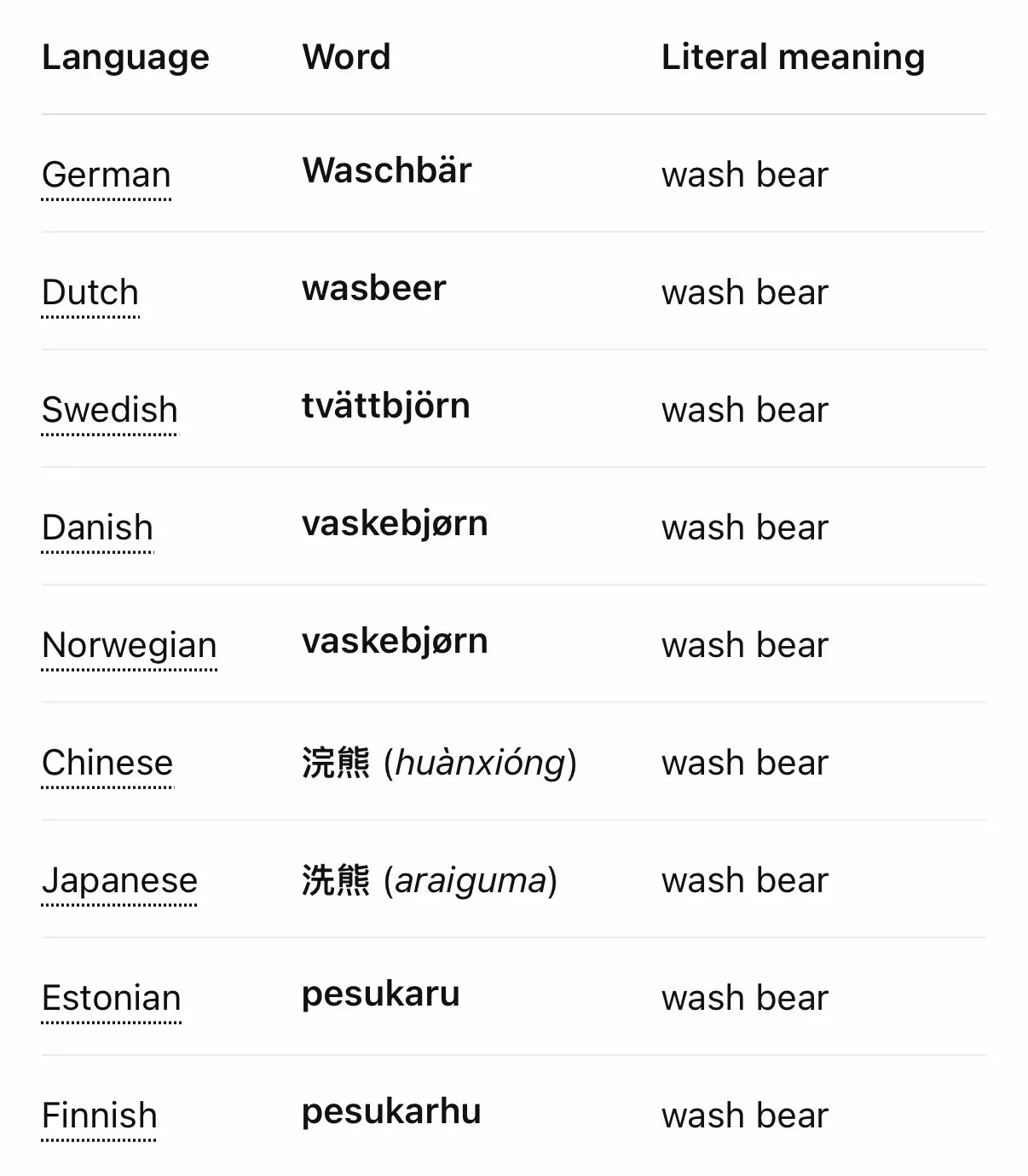
TIL: The raccoon, to a surprising number of quite disparate world languages, is the “wash bear”, derived from its habit of appearing to wash its food.

A table of the word for raccoon in nine languages — German Waschbär, Dutch wasbeer, Swedish tvättbjörn, Danish and Norwegian vaskebjørn, Chinese 浣熊, Japanese 洗熊, Estonian pesukaru, Finnish pesukarhu — every one of them literally meaning “wash bear”.

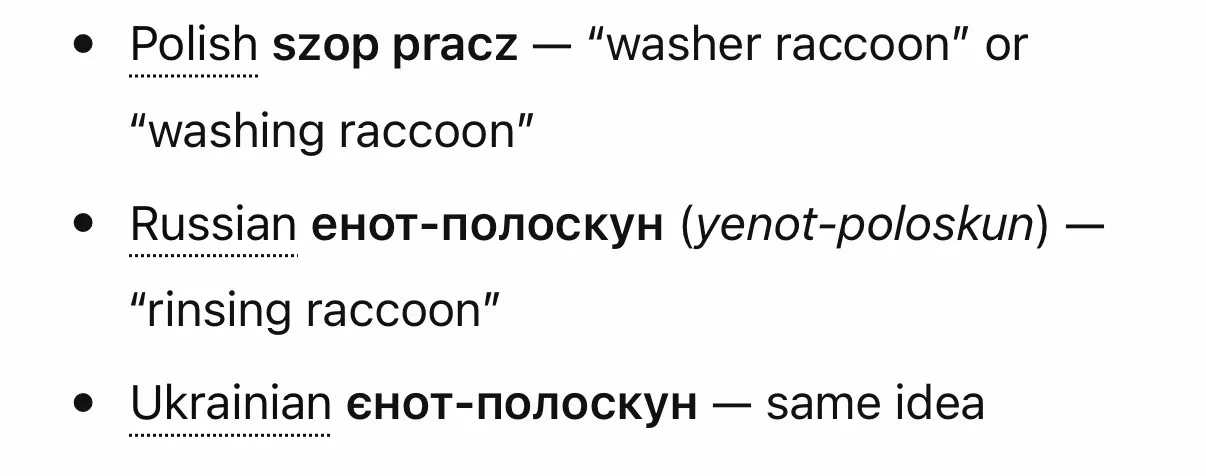
A list continuing the raccoon etymologies: Polish szop pracz (“washer raccoon”), Russian енот-полоскун (“rinsing raccoon”), and Ukrainian єнот-полоскун, the same idea.

Related: The real names of animals!

Published

Sometimes dual language signs really highlights how much better other languages are at expressing certain things. Compare “to give birth” with “dar a luz” (“to give to the light”)

What is the origin of “dar a luz”, referring to giving birth?

Does anyone know the origin of the phrase “dar a luz”, meaning “give birth”? Where or whom did this phrase come from? Is it unique to the Spanish language?

Published

The Senegalese football team is nicknamed “the lions of teranga”. Aside from a reference to the country’s literal lions, “lions” connote ferocity. “Teranga”is a Wolof word summarizing the Senegalese national character, and roughly means “hospitality”. “Fiercely hospitable” is a great vibe!

Know the nicknames of Group C teams at the TotalEnergies AFCON 2023

As we approach the TotalEnergies CAF Africa Cup of Nations, Côte d’Ivoire 2023, we take a close look at the nicknames of the teams in Group C of the competition.

Published

#crossculturalcommunication

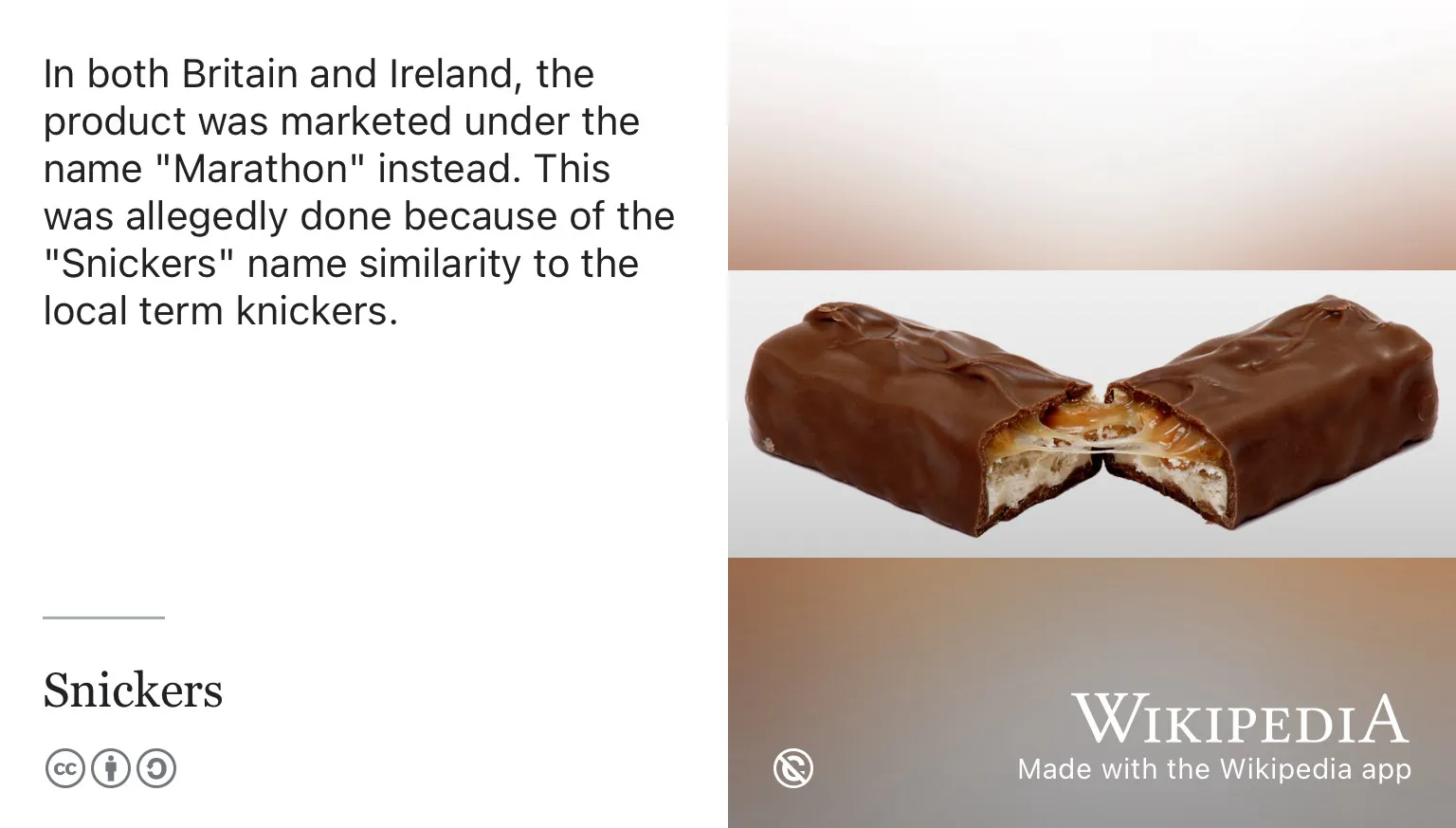
Wikipedia app screenshot of the “Snickers” article, noting the bar was marketed as “Marathon” in Britain and Ireland because of the name’s similarity to “knickers”, beside a photo of a Snickers bar snapped in half.

TIL: The Chinese character 聰, meaning intelligent, is comprised of 耳 (ear) + 悤 (smarts).

悤 , in turn, is 囪 (window) and 心 (heart): “a mind as clear and transparent as a window”.

The original meaning was “ears that hear very clearly”.

The Story of 聰

聰 is composed of 耳 (ear) and 悤 (haste, intelligent). 悤 is formed from a variant of 囪 (chimney, window) and 心 (heart), conveying the idea of a mind as clear and transparent as a window, already…